Vacation Rental Software Can Manage Bookings. But Who Answers The Guest?
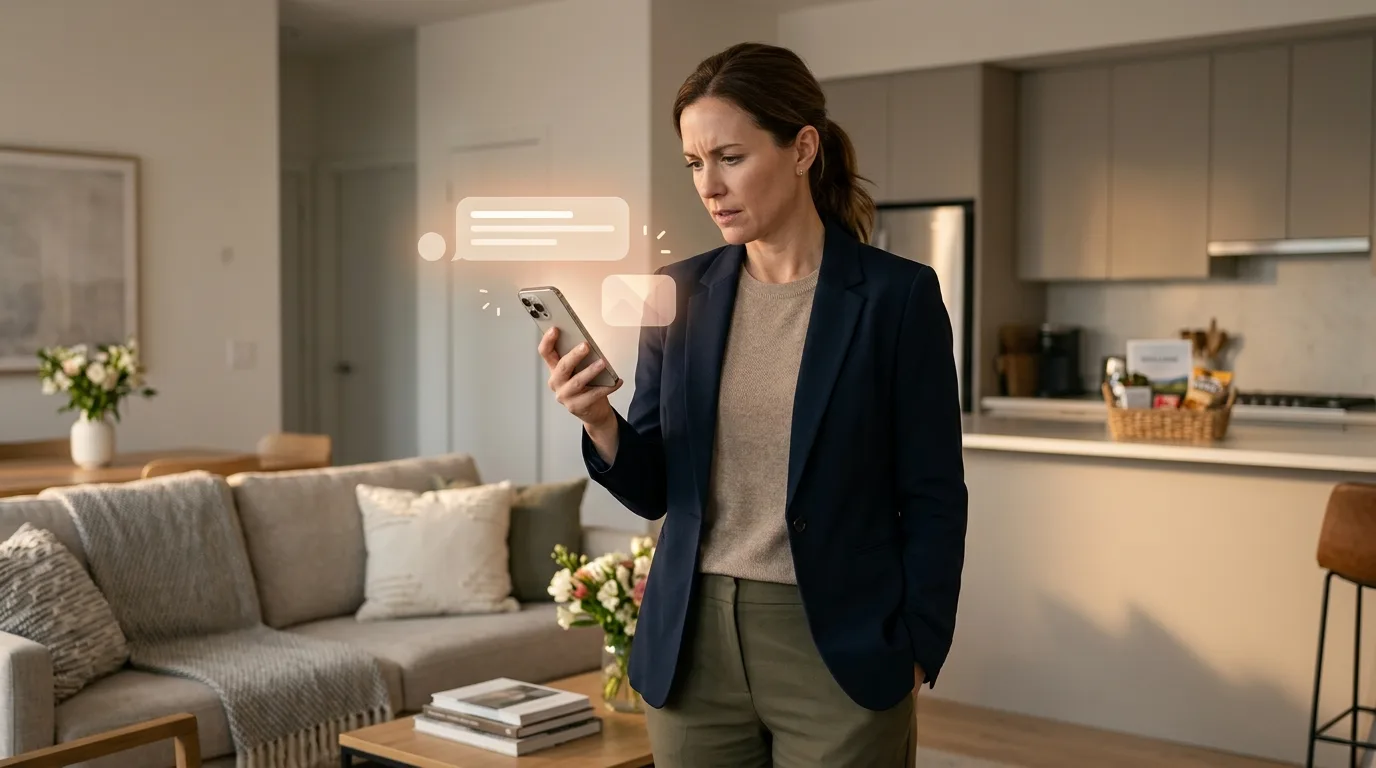
Why bookings can look organized while guest replies still interrupt the team
Introduction
Most vacation rental software demos make the business look solved.
The calendar is tidy. Rates are connected. Arrivals are visible. Cleaning tasks have owners. The reporting view looks like management has finally moved out of spreadsheets and inbox memory.
That is useful, but it is not the whole operating problem.
The buying mistake is assuming that a managed booking automatically creates a managed guest experience. It does not. A reservation can be perfectly synced while the guest still waits for a parking answer, an early check-in decision, a Wi-Fi fix, or a human escalation when something goes wrong.
That is the gap property managers often miss when they search for vacation rental software. A PMS or channel manager can organize the reservation side of the business, but the guest experience still depends on who replies, how fast they reply, what they say, and when they escalate the message to a human.
Vacation rental software can organize bookings while still leaving the most time-sensitive part of the guest experience unmanaged: the reply.
The booking side is only half the operation
Most vacation rental software comparisons focus on the obvious operational foundation. Does the system sync availability across Airbnb, Vrbo, Booking.com, and direct bookings? Does it prevent double bookings? Can it handle reservations, payments, owner statements, cleaning tasks, rate tools, and reporting?
Those questions matter. A growing property management business cannot run on a shared calendar and a few saved inbox replies.
But the cleanest booking dashboard can hide the messiest part of the day.
Guest communication does not arrive as one tidy workflow. It arrives as questions, exceptions, complaints, requests, and last-minute confusion. Some messages are routine. Some are revenue opportunities. Some can hurt a review if they sit too long. Some should never be answered automatically because they need judgment, context, or a real operational fix.
This is why vacation rental software should not be evaluated only by what it can store, sync, and report. It should also be evaluated by what happens after a guest asks a question.
If bookings double and guest messages double with them, the software has organized the workload. It has not reduced it.
Platform tools prove the problem is real
The major booking platforms already treat messaging as part of the operating system.
Airbnb documents scheduled quick replies that can send messages around reservation events such as booking, check-in, and checkout. Vrbo explains that message templates can help owners and managers respond faster to travelers and automate routine messages based on timing or booking events. Booking.com gives partners tools for message templates, scheduled templates, automatic replies, notifications, placeholders, and language handling.
That does not mean native platform tools solve the whole communication problem. It means the platforms all recognize the same operational truth: guests need timely, consistent information before, during, and after the stay.
Templates are useful when the question is predictable. Scheduled messages are useful when timing is predictable. Basic automatic replies are useful when the request falls inside a clear policy.
The harder work begins when the message needs context.
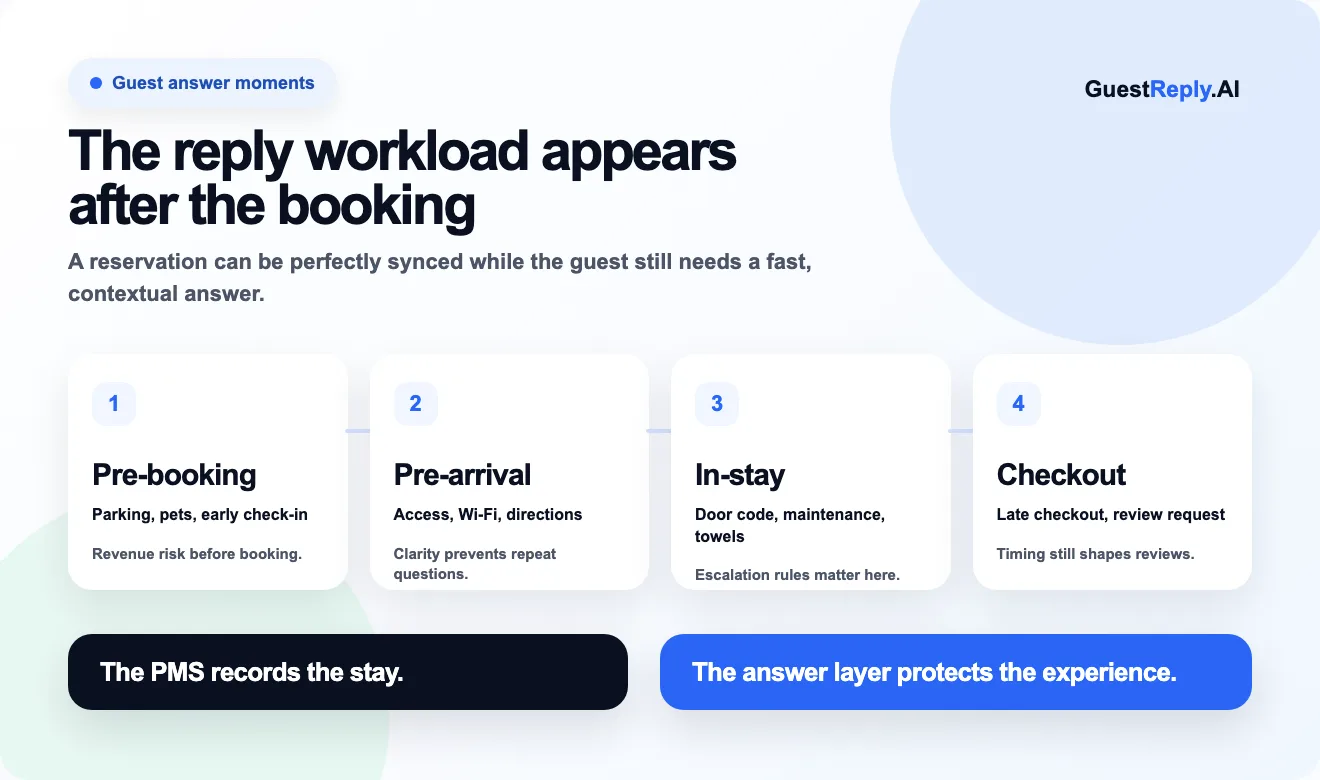
An early check-in request may depend on housekeeping. A parking question may depend on the exact unit. A refund complaint may need human judgment. A broken lock at 11:30 PM should not be treated like a normal FAQ. A multilingual guest should not wait until the one person on the team who speaks that language is online.
Native tools help with pieces of the journey. Growing operators need the journey managed across channels, properties, policies, staff members, and exceptions.
The guest does not care which system owns the answer
Inside the company, the software stack has names. PMS. Channel manager. Unified inbox. Task tool. Smart lock system. Pricing tool. CRM. Direct booking engine.
The guest does not care about that architecture.
The guest cares whether the answer is correct, fast, and useful. They want to know whether they can check in early, where to park, how to get inside, what to do if the Wi-Fi drops, whether the baby cot is available, and who will help if something goes wrong.
Expedia Group's short-term rental guest research with Phocuswright frames guest expectations and booking behavior as information operators should use to improve the business. For property managers, that is the practical point: communication is not a soft layer added after operations. It is where the guest experiences the operation.
If the software stack cannot turn reservation data, property rules, channel context, and operational status into a reliable answer, the team becomes the integration layer. Staff members copy details from one system, check another, ask someone in Slack, and finally reply to the guest.
That works when the portfolio is small. It breaks when the same pattern repeats hundreds of times a week.
Slow replies are not just an admin problem
Pre-booking messages deserve special attention because they can affect revenue before the reservation exists.
Harvard Business Review's article The Short Life of Online Sales Leads is not about vacation rentals specifically, so it should not be overused as industry proof. But its broader lesson is relevant: online inquiries lose value when companies respond too slowly.
In vacation rentals, a guest asking about parking, pets, bed setup, neighborhood noise, or early check-in is often still deciding. If the reply comes too late, the guest may not wait. They may choose a listing where the answer appears faster, clearer, or more confidently.
That is why response time should be managed as part of the software stack, not left to inbox luck.
The question is not only, "Can the PMS show the booking?" It is, "Can the operation answer the guest while the guest is still ready to book?"
A guest communication layer needs more than a unified inbox
A unified inbox is helpful. It gives the team one place to see messages from different channels. But visibility is not the same as resolution.
If a unified inbox still requires a human to read every message, find the answer, write the reply, translate the reply, check the policy, and decide whether to escalate, the inbox has centralized the work. It has not removed much of it.
A real guest communication layer needs several capabilities working together.
It needs reservation and property context, so replies are specific to the stay instead of generic. It needs message triggers, so routine communication happens at the right moment. It needs AI reply control, so repetitive questions can be answered quickly without handing sensitive cases to automation blindly. It needs multilingual support, because guest demand does not always match staff language coverage. It needs escalation rules, so maintenance, safety, refunds, complaints, and unusual requests reach a human. It needs reporting, so managers can see whether response time, automation coverage, and unresolved message volume are improving.
Zendesk's 2025 CX Trends Report is useful here because it points toward human-centric AI, personalization, and careful management of AI service workflows. For vacation rental property managers, the lesson is not to let AI answer everything. The lesson is to define which messages are safe to automate, which should be reviewed, and which should escalate immediately.
Automation without guardrails creates risk. Manual control without automation creates workload. The useful middle is controlled automation.
Should your PMS do all of this?
It is reasonable to ask whether vacation rental software should simply include deeper guest communication automation inside the PMS.
Sometimes it does enough. For a smaller operator with predictable stays, one or two channels, and manageable message volume, native PMS messaging and platform templates may be sufficient. There is no need to add specialist software before the workflow justifies it.
The threshold changes when guest communication becomes a management problem instead of a typing problem.
That usually shows up in familiar ways. Several team members answer guests differently. Pre-booking questions wait too long. Night and weekend coverage depends on whoever notices the message. The same check-in questions interrupt the team every day. Managers cannot tell which messages are automated, which are unresolved, and which issues are being escalated too late.
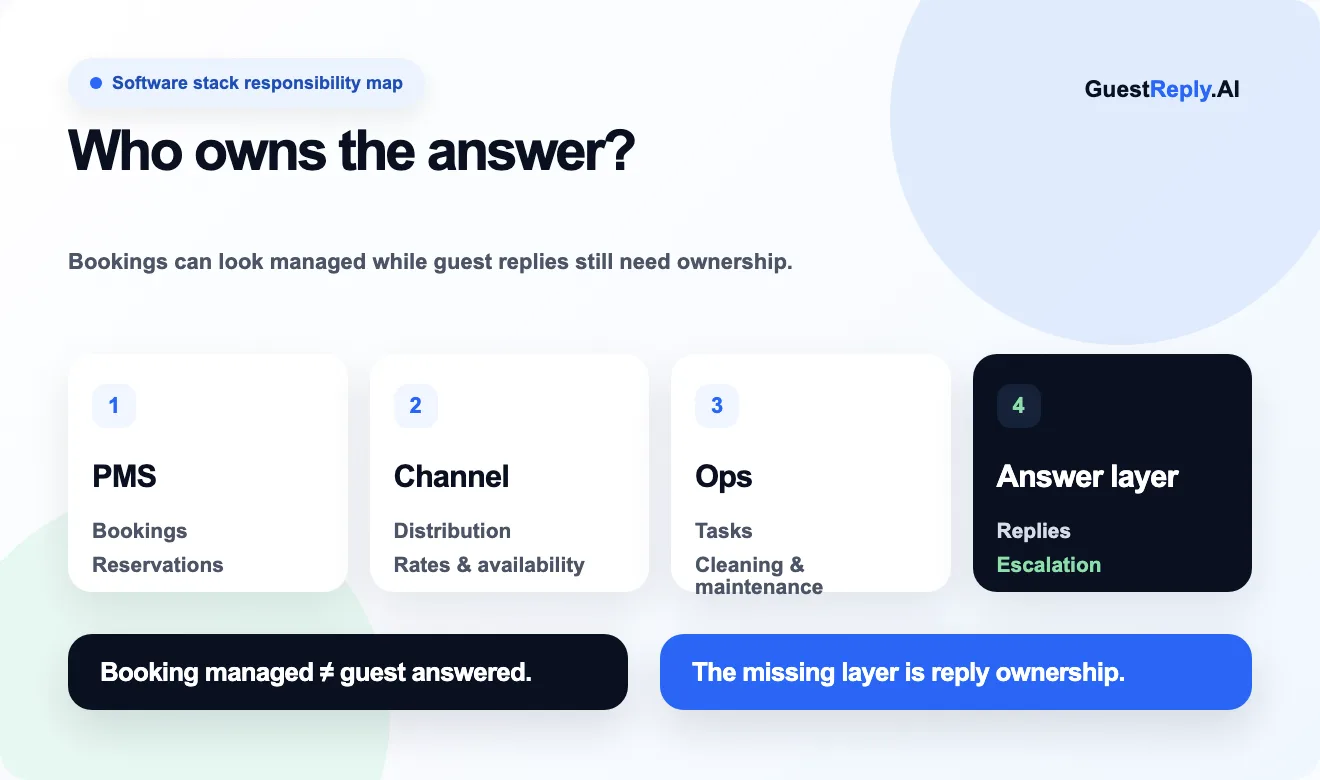
At that point, the choice is not "PMS or guest communication software." The stronger model is a stack where each layer does its job well.
The PMS manages reservations, property data, calendars, reporting, and core operations. The channel manager keeps distribution synchronized. Cleaning and maintenance tools coordinate work. A guest communication layer handles the repeated, time-sensitive, multilingual, and escalation-sensitive conversations that sit on top of those systems.
If you are comparing the broader software stack, the related question from the first GuestReply AI article is also worth asking during a short-term rental property management software evaluation: if your team still has to babysit every guest reply, what exactly did the software remove?
Where GuestReply AI fits
GuestReply AI is not a PMS replacement. It does not need to be.
GuestReply AI fits beside the systems that already manage reservations and operations. It acts as an AI guest communication layer for short-term rental property managers, focused on the place where daily work still piles up: guest replies.
The live GuestReply AI homepage makes the product promise concrete: automate 92% of guest communication, reply in under 1 minute, support 80+ languages, cut workload by 90%, improve pre-booking conversions by 10%, and go live in under 5 minutes. Those claims matter because they map directly to the communication gap vacation rental software often leaves behind.
The important part is control. GuestReply AI supports both Co-Pilot and Autopilot modes, so teams can review AI responses before moving into fuller automation. It also uses smart escalations when a message needs human input. That matters because the goal is not to remove humans from hospitality. The goal is to stop using humans for repetitive replies that software can safely handle, while bringing humans in faster for the moments that require judgment.
What to ask before you choose vacation rental software
Before choosing or replacing vacation rental software, evaluate the booking layer and the reply layer separately.
Ask the usual PMS questions about channels, reservations, owner reporting, payments, cleaning, maintenance, accounting, direct bookings, and integrations.
Then ask the questions that reveal whether guest communication will still depend on manual effort:
Which guest messages can be answered without a human typing from scratch?
Can replies use reservation, property, policy, and channel context?
Can the system support Airbnb, Vrbo, Booking.com, WhatsApp, SMS, and email without fragmenting visibility?
Can managers approve AI replies before using full automation?
Which messages escalate automatically to a human?
Can the team see response time, unresolved messages, automation coverage, and escalation volume?
If bookings double, does guest message workload double too?
The last question is the buying test.
If the answer is yes, the stack is not finished. It may manage bookings well, but it has not solved the guest communication workload.
The buying takeaway
Vacation rental software should make the business easier to run. That means more than a clean calendar, a connected channel manager, and a reporting dashboard.
For property managers, the daily pressure often appears after the booking is already in the system. It appears when the guest asks a question, needs reassurance, changes plans, arrives late, reports a problem, or expects a fast answer in another language.
If your vacation rental software manages reservations but your team still watches every inbox, copies the same replies, and guesses which message needs attention first, the stack is missing a layer.
The next software decision should not only be, "Can this manage the booking?" It should also be, "Who answers the guest?"

If you want to see how GuestReply AI can add that communication layer beside your existing PMS, Start free trial. If you prefer to test the workflow first, you can also Start free trial.
FAQ
What is vacation rental software?
Vacation rental software helps property managers run short-term rental operations. Depending on the platform, it can manage calendars, reservations, channel sync, payments, cleaning, owner reporting, direct bookings, guest communication, and integrations.
Does vacation rental software include guest messaging?
Many vacation rental software platforms include a unified inbox, templates, or scheduled messages. Those features are useful, but they are not always the same as a full guest communication workflow with AI assistance, multilingual replies, escalation rules, and response-time reporting.
Is GuestReply AI vacation rental software?
GuestReply AI is not a full PMS or channel manager. It is an AI guest communication and operations layer for short-term rental property managers. It works alongside the broader vacation rental software stack to automate and assist guest replies.
When should property managers add guest messaging software?
Add guest messaging software when repeated questions, slow replies, multi-channel conversations, staff handoffs, multilingual guests, or escalation issues become a management problem instead of a simple inbox task.
Should I replace my PMS to improve guest communication?
Not necessarily. If your PMS handles reservations and operations well, it may be better to add a specialist guest communication layer rather than replace the foundation of your stack. The right choice depends on where the workload actually breaks.
