Babysitting Guest Messages? Your Vacation Rental Software Is Missing Something.
How to evaluate the missing guest communication layer in your software stack
Introduction
It is 9:40 PM. Your PMS is clean. The calendar is synced. Tomorrow's check-ins are visible. The owner report is fine. On paper, the operation looks controlled.
Then the messages start stacking up.
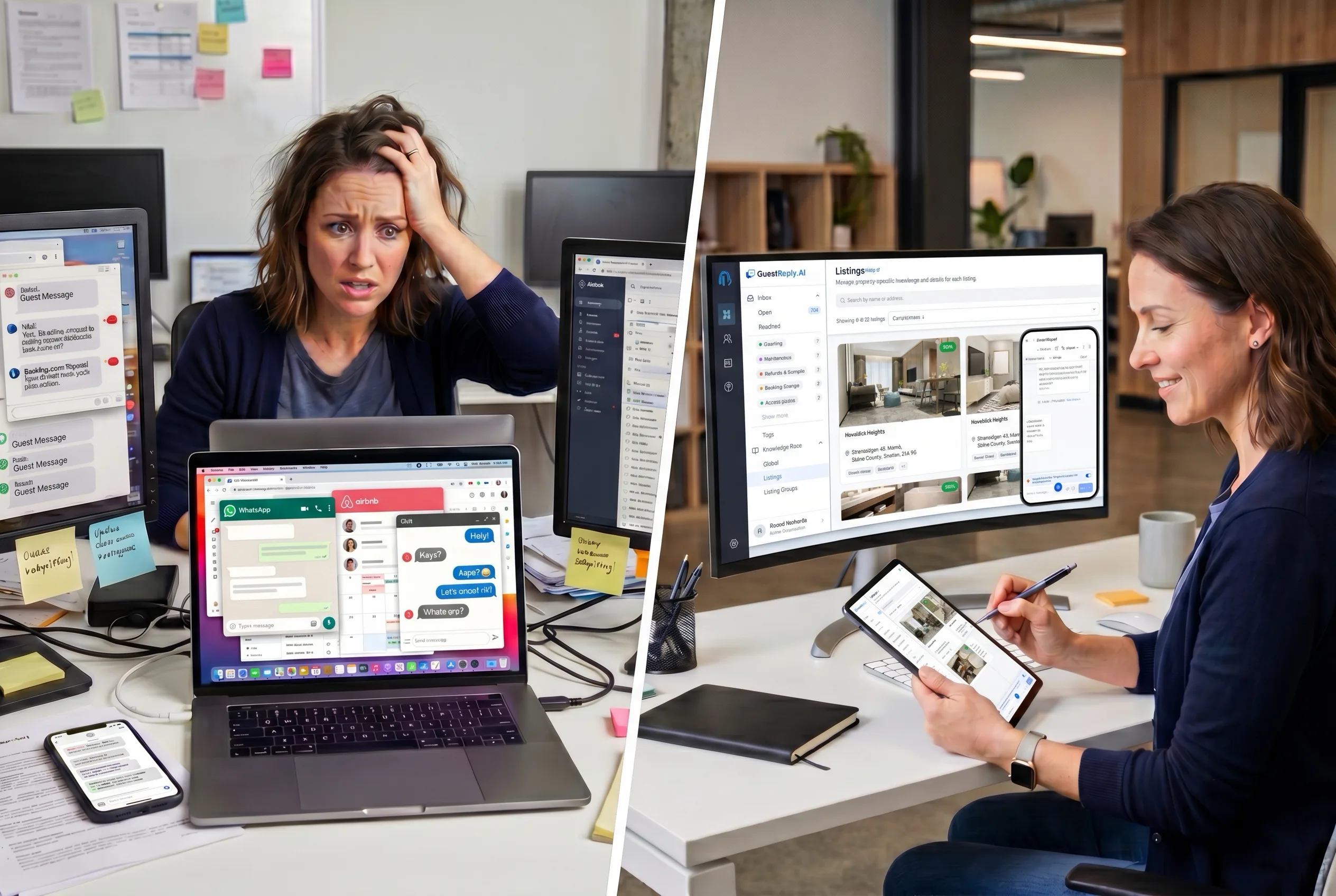
One guest asks whether the sofa bed is made up. Another wants early check-in. A third cannot find the parking instructions. Someone who booked through Vrbo is now messaging on WhatsApp. A pre-booking inquiry asks about pet rules while your team is still dealing with a door-code issue from another property.
Nothing is technically broken. The reservation system is doing its job. The channel manager is doing its job. The task tool may even be doing its job. But your team is still watching inboxes, copying answers, chasing context, and deciding which message needs a human reply right now.
That is the gap many property managers miss when they search for the best short-term rental property management software. A strong PMS can manage reservations. It does not always reduce the daily work of guest communication.
Vacation rental software is incomplete if it manages bookings but still leaves guest replies scattered across inboxes and staff members.
The software demo usually looks cleaner than the workday
Most short-term rental software comparisons start in a reasonable place. Property managers look at calendar management, channel sync, reservation handling, owner reporting, cleaning workflows, accounting, direct booking tools, and integrations. Those features matter. A growing portfolio cannot run on spreadsheets and inbox memory.
The problem is that software demos often make guest communication look smaller than it feels in real operations.
In a demo, messaging is a tab. In the workday, messaging is the thing that interrupts every other tab.
A guest message can be a simple Wi-Fi question. It can also be a revenue moment, a review risk, a maintenance issue, a fraud concern, a refund dispute, or an access emergency. The same inbox can contain a pre-booking question worth hundreds of dollars and a routine checkout reminder that should never need a human in the first place.
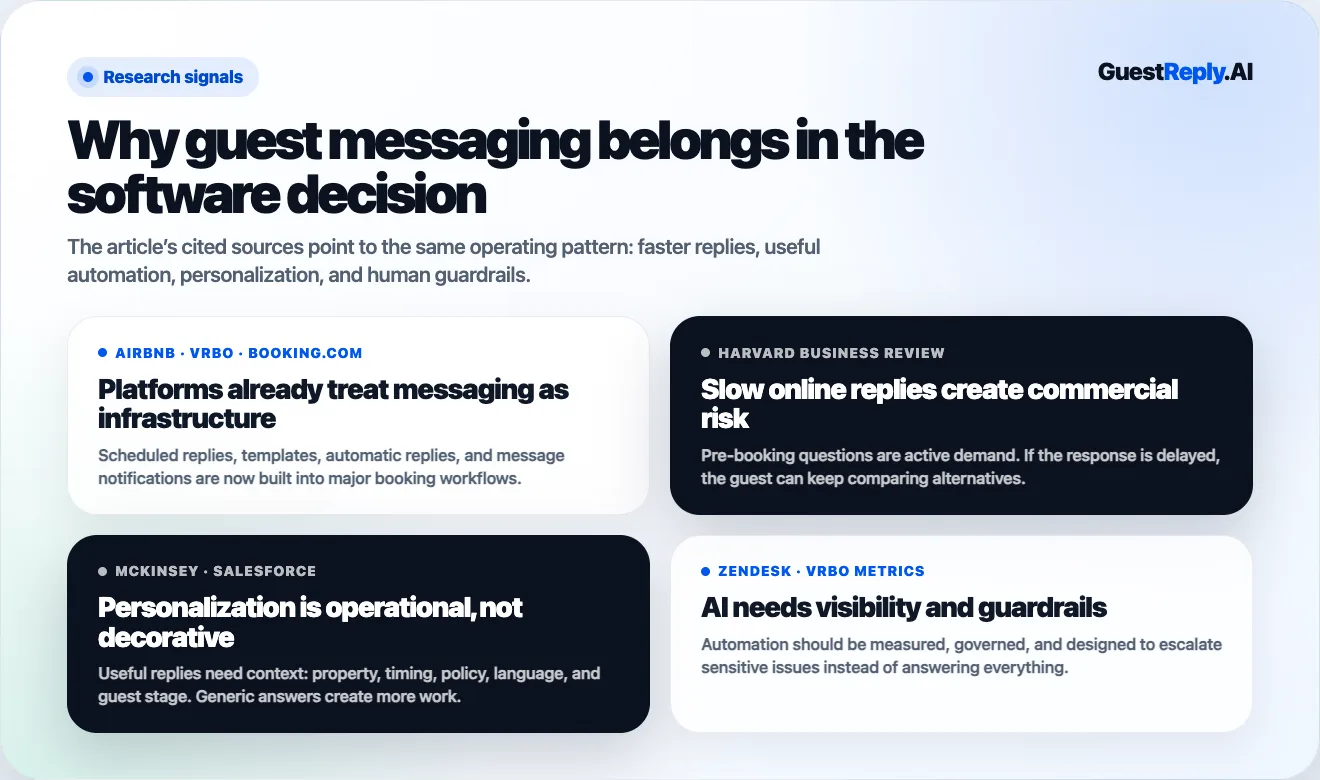
That is why the question should not only be, "Which PMS has the most features?" It should be, "If bookings double, does guest communication double too?"
If the answer is yes, the stack has not solved the workload problem. It has organized the workload.
Booking platforms already know messaging is operational infrastructure
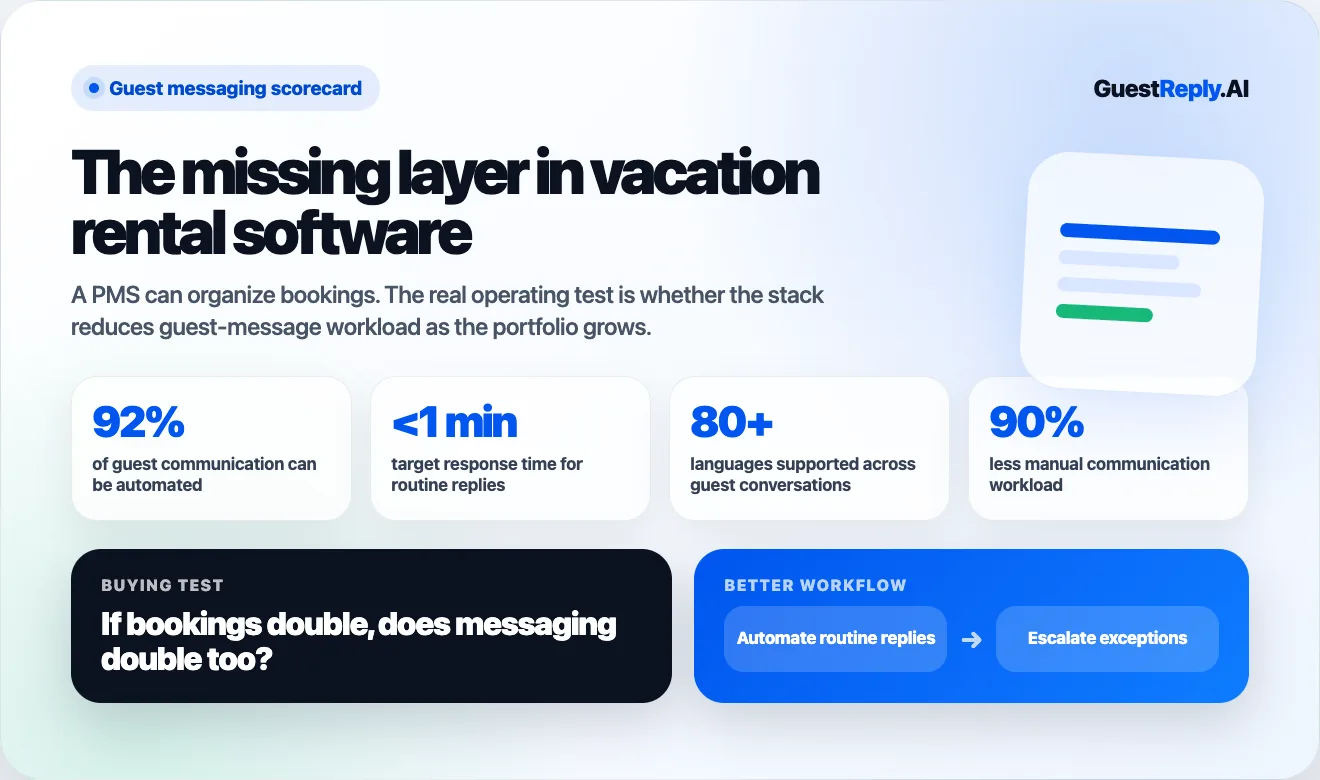
Guest messaging is not a side task that only matters to unusually demanding guests. The major booking platforms have already built messaging tools because guest communication affects operations, response speed, and booking confidence.
Airbnb documents scheduled quick replies that can be triggered around events such as booking, check-in, and checkout. Vrbo documents message templates for common questions and routine messages. Booking.com explains how partners can set up templates, automatic replies, scheduled templates, notifications, and language-specific message handling.
Those tools prove the baseline need. Guests ask many of the same questions at predictable moments, and platforms want hosts and managers to answer more consistently.
But native templates do not automatically become a scalable communication operation. A scheduled check-in note helps. It does not decide whether a frustrated guest with a broken lock should be escalated. A saved pet-policy answer helps. It does not guarantee that every staff member gives the same answer across Airbnb, Booking.com, SMS, and WhatsApp. A template library helps. It does not show whether response time is improving across the portfolio.
For small operators, native tools may be enough for a while. For growing property managers, they often become a patchwork.
The hidden evaluation layer is guest communication
When a property manager evaluates vacation rental software, the visible categories are easy to compare. Does the PMS support the right channels? Does it handle owner statements? Does it integrate with accounting? Does it prevent double bookings? Does it support the portfolio size the company expects to reach?
Guest communication needs the same level of scrutiny.
The practical test is simple: follow one reservation from inquiry to review and ask what still requires a human to notice, decide, type, approve, or escalate.
Before booking, a guest may ask about parking, pets, bed setup, amenities, location, early check-in, or whether the home suits a group. Harvard Business Review's article The Short Life of Online Sales Leads is not about vacation rentals specifically, but the broader lesson applies: online inquiries lose value when companies respond too slowly. In short-term rentals, a slow pre-booking answer can send the guest back to the search results.
After booking, the guest needs confidence. They want to know what happens next, when check-in details arrive, how access works, and who to contact if something changes. Before arrival, the same questions repeat across listings: parking, Wi-Fi, door codes, luggage, pets, amenities, local instructions. During the stay, the stakes get higher because a message may become an operational issue. After checkout, review requests and follow-ups still need timing and tone.
This is why guest messaging should not be treated as a small PMS feature. It is a workflow that touches revenue, guest satisfaction, staff workload, and reviews.
Where templates help, and where they stop helping
Templates are useful. Scheduled messages are useful. Basic automatic replies are useful. They remove blank-page typing and prevent some routine work from falling through the cracks.
The limitation appears when the operation becomes more complex than the template.
An early check-in question may depend on housekeeping status. A parking question may depend on the specific unit. A refund request may need human judgment. A door-code issue at night should not be handled like a normal FAQ. A guest messaging from one channel about a booking made on another channel needs context, not just a saved answer.
This is where broader customer-experience research matters. Zendesk's 2025 CX Trends Report emphasizes human-centric AI and the need to manage AI carefully. Salesforce's State of the AI Connected Customer points to customer expectations around personalization and transparency, including when AI agents are involved. For property managers, the lesson is not "automate everything." The lesson is to automate the right work with clear guardrails.
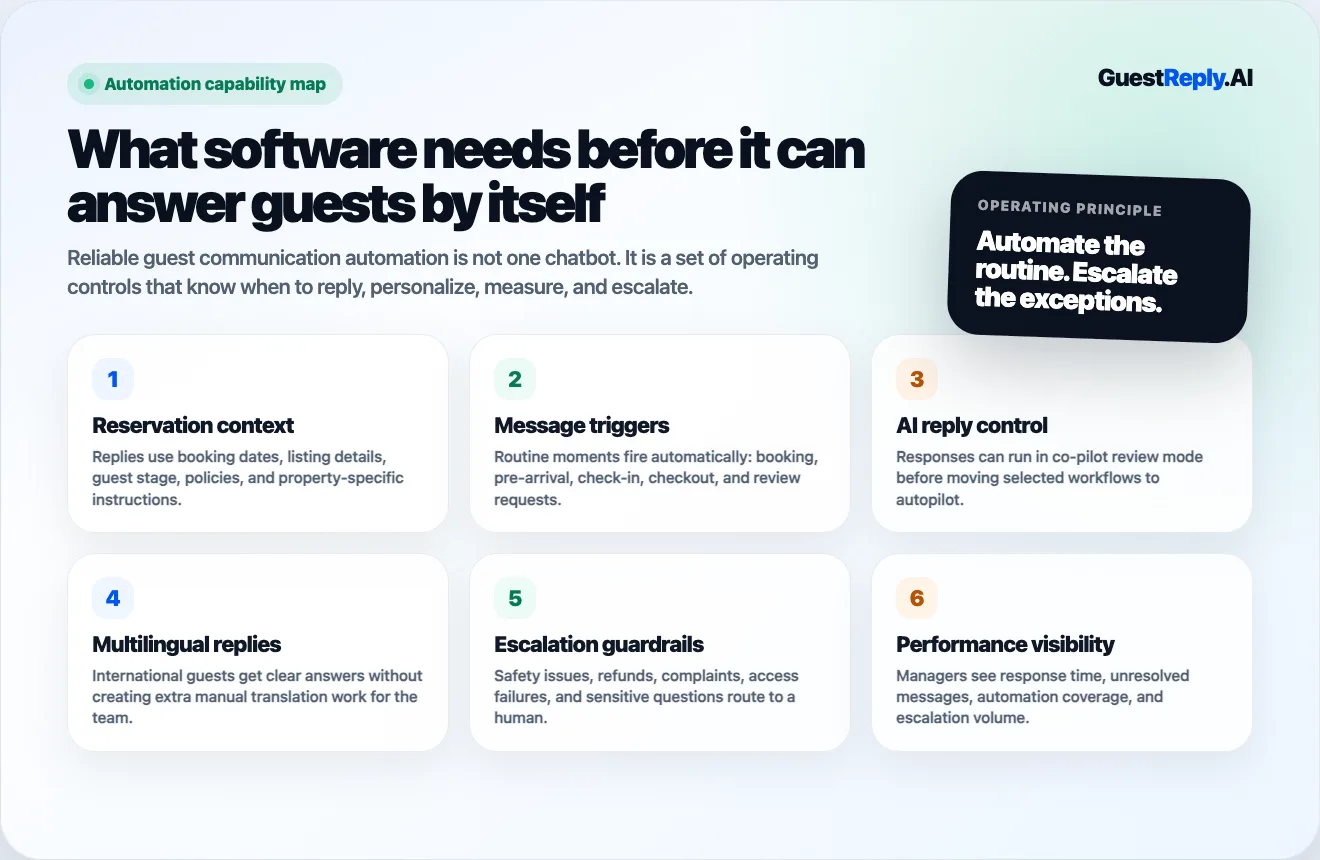
Good guest communication automation should answer repetitive, low-risk questions quickly. It should personalize replies with reservation and property context. It should support multiple languages where the portfolio needs it. It should show the team what has been handled. And it should escalate sensitive messages before automation creates a guest-experience problem.
Automation without escalation is risky. Manual control without automation is expensive. The best stack gives you both.
Response time should be managed, not guessed
Most property managers know slow replies are bad. Fewer can see exactly where response time breaks down.
Vrbo's own documentation on responsiveness metrics includes message timers and guidance around timely booking-request responses. Even if your internal target is faster than the platform baseline, the operational principle is the same: response time should be visible.
Without measurement, messaging becomes a feeling. The team thinks it is responsive because urgent messages usually get answered. Meanwhile, pre-booking questions wait too long, repeated in-stay questions eat staff time, and nobody can say which channels create the most interruptions.
A better software evaluation asks whether the stack can show practical communication signals: average response time, unresolved messages, repeated questions, automation coverage, escalation volume, and channel-level workload. Those numbers turn guest messaging from an inbox habit into an operating system.
Personalization is not decoration in guest communication
Property managers sometimes hear "personalization" and think of marketing language. In guest communication, personalization is more basic and more operational.
It means the reply knows which property the guest booked. It knows the check-in date. It knows whether the guest is asking before booking, before arrival, during the stay, or after checkout. It understands the relevant policy and does not send a generic answer that creates more confusion.
McKinsey's explainer on personalization describes the broader customer expectation: people increasingly expect interactions to be relevant and get frustrated when companies fail to deliver that relevance. In a vacation rental, relevance is not only a better experience. It can prevent repeat messages, reduce mistakes, and protect the team from avoidable follow-up work.
Expedia Group's short-term rental research with Phocuswright also reinforces the point that guest expectations and booking behavior should shape operations. If guests expect clarity before they book, confidence before they arrive, and fast support during the stay, the software stack has to support those moments.
What to ask before choosing short-term rental software
The buying conversation changes once you treat messaging as a core workflow.
You still need to evaluate the PMS, channel manager, operations tools, reporting, accounting, and integrations. But before you call the stack complete, add a communication pass to the evaluation.
Ask these questions during the demo or internal review:
If reservations double, what happens to guest message volume?
Which guest questions can be answered without a human click?
Which messages escalate automatically to a manager?
Can replies use property, reservation, and policy context?
Can the team manage Airbnb, Vrbo, Booking.com, WhatsApp, SMS, and email without fragmented visibility?
Can the system support multilingual guests without slowing the team down?
Can managers see response-time and escalation performance?
Can staff review AI replies before moving to full automation?
That last question matters. The goal is not to replace human hospitality with uncontrolled automation. The goal is to stop using humans for work that software can safely handle, while keeping humans close to the messages that require judgment.
Where GuestReply AI fits in the stack
GuestReply AI is not a PMS replacement. Your PMS should continue to manage reservations, property data, calendars, reporting, and the workflows it already handles well.
GuestReply AI fits where the daily communication workload lives. It is an AI guest communication layer for short-term rental property managers that helps automate and assist guest replies across routine questions, pre-booking inquiries, multilingual conversations, response-time pressure, and escalation workflows.
The homepage promise is intentionally operational: automate 92% of guest communication, reply in under 1 minute, support 80+ languages, reduce workload by 90%, and help improve pre-booking conversions. Those claims only matter if they connect to the problem property managers actually feel: too many guest messages requiring too much human attention.
The healthier model is not "one PMS must do everything." The healthier model is a stack where each layer does the job it is best suited for. The PMS manages the reservation foundation. The channel manager keeps distribution synchronized. Operations tools coordinate cleaning and maintenance. GuestReply AI handles the communication layer where repeated questions, channel fragmentation, language coverage, and escalation rules create daily work.
Native messaging may be enough, until it is not
There is no need to overcomplicate a small operation. If one person can comfortably answer messages, most questions are predictable, and response expectations are easy to meet, native templates and scheduled messages may cover the basics.
The threshold changes when guest communication becomes a management problem instead of a typing problem.
That usually happens when messages arrive across multiple channels, several team members answer guests, response time affects booking conversion or reviews, repeated questions interrupt operations, or urgent issues get buried beside routine FAQs. At that point, buying software only around calendars and reservations leaves a major workload untouched.
For a growing operator, the question is not whether the PMS has a messaging tab. The question is whether the stack can reduce the number of guest replies your team has to babysit.
The buying takeaway
The best short-term rental property management software is not simply the tool with the cleanest calendar, longest feature list, or most polished demo.
For property managers, the best stack is the one that reduces real operational load. Guest messaging is one of the clearest places to test that promise because the work is frequent, repetitive, time-sensitive, and directly visible to the guest.
If your PMS manages bookings but your team still watches five inboxes all day, the stack is incomplete. The next software decision should not only be about calendars, owner reports, or channel sync. It should also be about how many guest messages your team no longer has to babysit.
If you want to see how GuestReply AI can fit alongside your existing PMS and reduce guest communication workload, Start free trial. If you prefer to test the workflow first, you can also Start free trial.

FAQ
What is the best short-term rental property management software?
The best short-term rental property management software depends on portfolio size, channel mix, reporting needs, owner workflows, and team structure. For growing operators, the best stack should also reduce guest communication work, not only manage reservations and calendars.
Is guest messaging included in most vacation rental software?
Many platforms include messaging, templates, or scheduled messages. Those tools are useful, but they are not always the same as a full guest communication workflow with automation, context, escalation, multilingual support, and response-time visibility.
Should a property manager choose an all-in-one PMS or add specialist tools?
An all-in-one PMS can be a strong foundation. Specialist tools make sense when a frequent workflow needs deeper capability than the PMS provides. Guest communication is often one of those workflows because it touches response speed, staff workload, guest experience, and escalation risk.
When should a property manager add guest messaging software?
Add guest messaging software when your team repeatedly answers the same questions, messages arrive across several channels, response time affects bookings or reviews, or urgent guest issues get buried in general inbox traffic.
Does GuestReply AI replace my PMS?
No. GuestReply AI supports the guest communication layer. Your PMS can continue handling reservations, property data, calendars, and reporting while GuestReply AI helps automate and assist guest replies across the communication workflow.
