If Someone Has To Watch Your Vrbo Inbox All Day, The Workflow Is Broken.
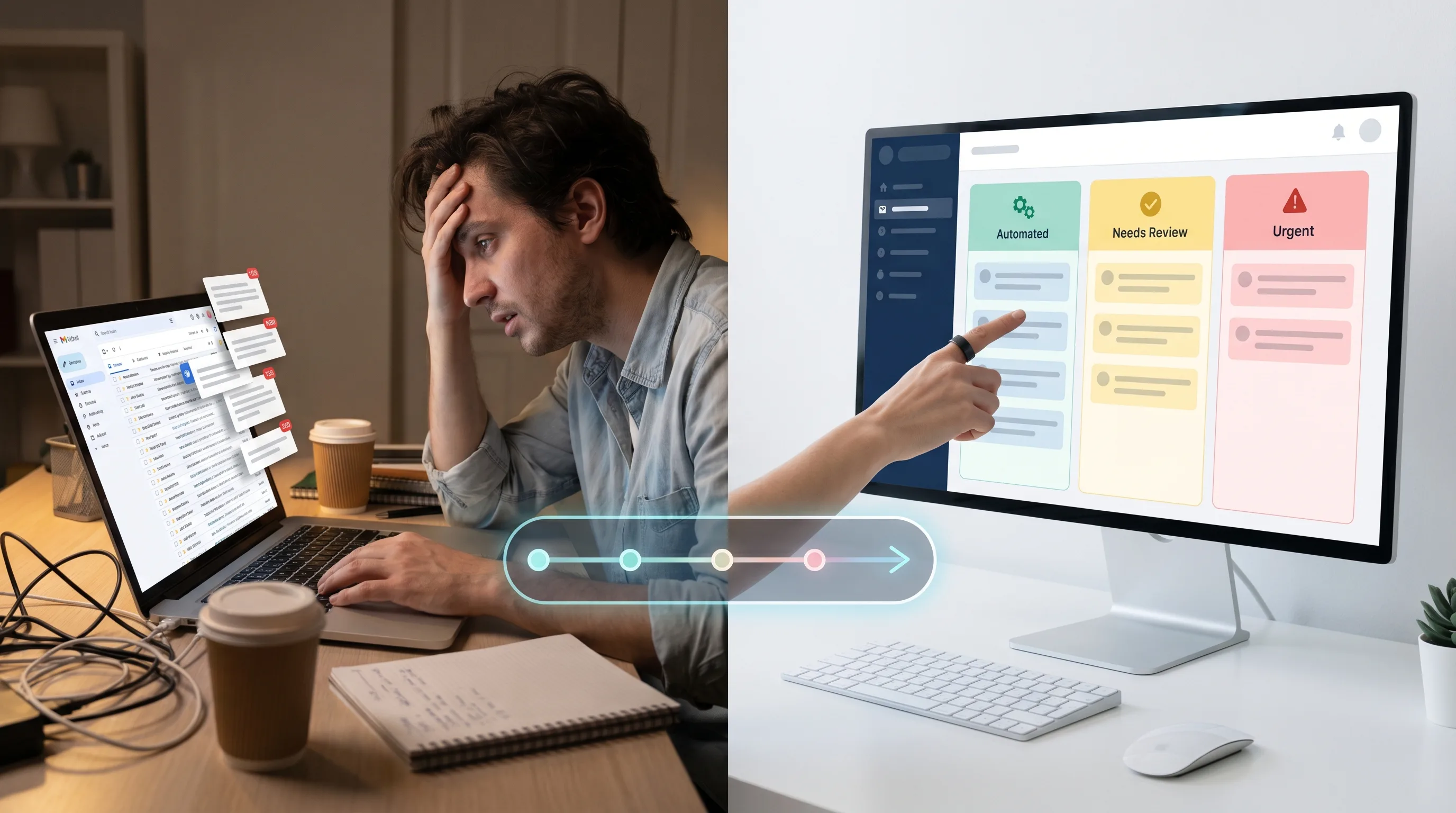
Guest communication automation for short-term rental property managers
Introduction
If the guest communication plan is "someone checks the Vrbo inbox," the workflow is already fragile.
That person may be fast. They may know the properties well. They may care deeply about the guest experience. But if every message depends on manual attention, Vrbo automated messages are not a nice add-on. They are the missing operating layer.
The inbox should not be the system. It should be one input into the system.
Inbox monitoring hides the real cost
Watching an inbox feels normal because messages arrive all day. But the cost is not only the reply time.
The cost is the interruption. The context switch. The repeated answer. The staff member checking property notes. The uncertainty about whether a message needs escalation. The risk that a routine question hides an urgent access problem.
Vrbo's responsiveness metrics make timely replies important. But a property manager should not depend on constant human monitoring to stay responsive.
Templates help, but they still need ownership
Vrbo documents message templates, and templates are a good start. They reduce blank-page writing and make common answers more consistent.
But templates do not fully answer the ownership question.
Who decides when the template is enough? Who updates it when a property instruction changes? Who notices that the guest is angry, confused, or locked out? Who escalates when the answer should not be automated?
A real workflow has rules for all of that.
The workflow should separate three kinds of messages
Routine messages should be automated or assisted quickly. These include Wi-Fi, parking, check-in timing, checkout instructions, amenity questions, and basic house rules.
Contextual messages should be answered with property and reservation data. These include questions about the specific stay, the specific unit, group fit, arrival timing, or local instructions.
Sensitive messages should escalate. These include complaints, refunds, access failures, safety issues, maintenance problems, and anything where the system is uncertain.
Airbnb's guest-message guidance notes that communication spans before, during, and after a stay (Airbnb Help). The same operational logic applies to Vrbo: the reply workflow needs to cover the full lifecycle.
Where GuestReply fits
GuestReply is an AI guest communication layer that works beside your current tools. It can help answer repeated Vrbo guest questions quickly, support multilingual replies, reduce manual inbox monitoring, and escalate sensitive issues.
Booking.com's partner tools also include templates and automatic replies (Booking.com), which reinforces the broader direction: travel operators are moving away from pure manual inbox handling.
For professional managers, the next step is not just more templates. It is a managed reply workflow.
The takeaway
If someone has to watch the Vrbo inbox all day, that person is acting as the automation layer.
That is expensive, fragile, and hard to scale.
Build a workflow where routine messages are handled quickly, context is used correctly, and exceptions escalate before they become guest problems.
If you want to see how GuestReply can reduce Vrbo inbox babysitting while keeping escalation in place, book a demo.
FAQ
What are Vrbo automated messages useful for?
They are useful for routine guest questions, arrival instructions, checkout reminders, review follow-up, and repeated pre-booking answers.
Why is inbox monitoring not enough?
Because it depends on constant human attention and does not reliably separate routine messages from urgent or sensitive issues.
Should guest complaints be automated?
Complaints should usually escalate or require human review, even if automation helps gather context or send a quick acknowledgement.
